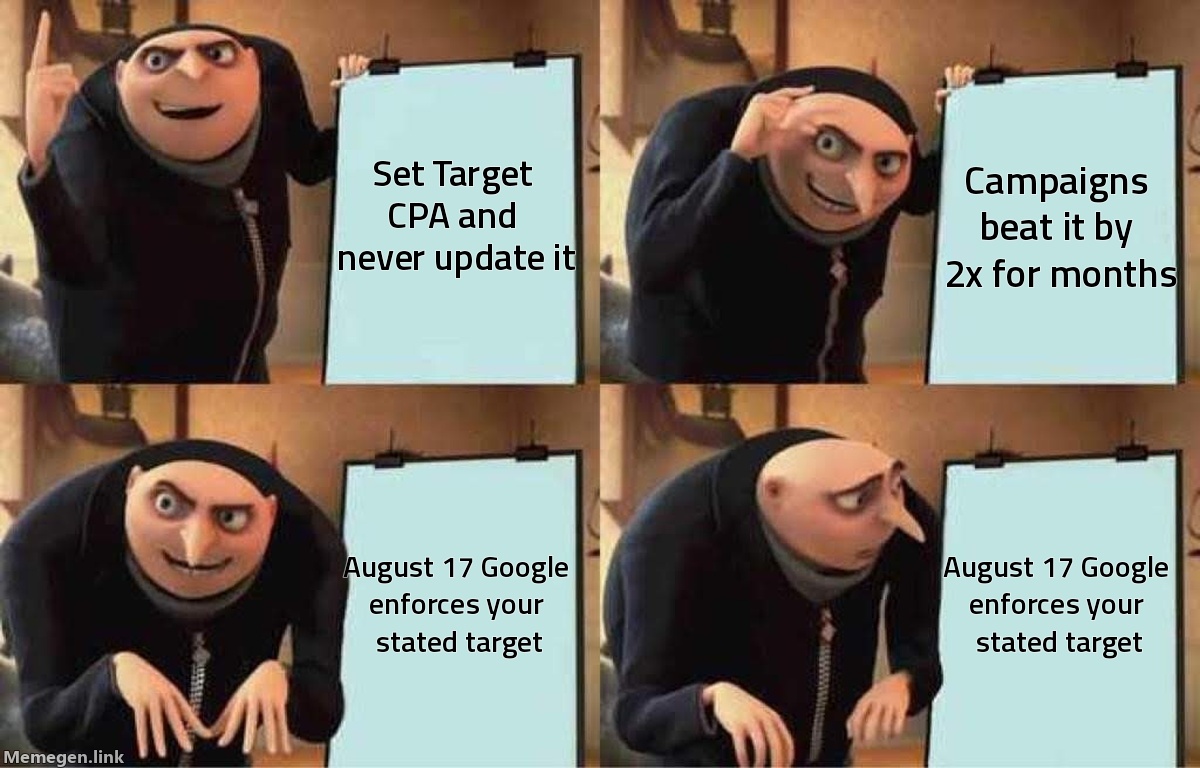
There's a change coming to Google Ads on August 17 that most advertisers won't notice until their CPA jumps and they blame the algorithm.
Starting that date, campaigns that are "Limited by budget" and running Target CPA or Target ROAS will align more closely with their stated targets — even when you adjust your budget. If your Target CPA is $10 but your actual CPA has been $5 for months, expect performance to drift toward $10.
This isn't a bug. It's Google doing exactly what you asked.
Why budget-limited campaigns behave differently right now
When a campaign is constrained by its daily budget, Smart Bidding optimizes for the most efficient conversions first — often delivering results well below your stated target. The budget runs out before the algorithm reaches the full range of auctions where your $10 CPA would be the realistic outcome.
That gap between stated target and actual performance has become comfortable for a lot of advertisers. They see $5 CPAs against a $10 target and call it a win. What's actually happening is the budget cap is filtering out the less efficient auction opportunities. After August 17, those won't be filtered anymore.
The algorithm will bid into the full range of available auctions. More volume, higher marginal CPAs, performance that lands closer to your stated target. For accounts that set conservative targets at launch and never revisited them, this will look like a regression in CPA.
Who gets blindsided
Two types of accounts have the most exposure here.
Accounts where initial targets were set as placeholders, budget was raised over time, but targets weren't updated. The gap between a stated $15 CPA and an actual $7 CPA has been widening quietly.
E-commerce accounts running PMax and Shopping with conservative ROAS targets that were never revised after the early period. A target ROAS of 3x that's been delivering 9x is exactly the type of campaign this update affects.
The change applies to Search, Shopping, Performance Max, Demand Gen, and Travel campaigns in Google Ads and Search Ads 360 — and Demand Gen campaigns in Display & Video 360. Campaigns that are not "Limited by budget" are unaffected.
The timeline
Now: Pull every campaign showing "Limited by budget" status that's using Target CPA or Target ROAS. Compare stated target to actual performance over the past 60 days. Any gap of 1.5x or more should be on your fix list.
July 6: The Bid Target Adjustment Tool becomes available in Google Ads. You'll get an in-account notification. The tool shows historical performance against stated targets and lets you apply recommended updates across campaigns in bulk.
August 17: New bidding behavior goes live. Any gap between your stated target and actual performance at that point becomes the correction zone.
What actually needs to change
Lowering your Target CPA to reflect actual performance feels counterproductive. You're asking less. But what you're telling the system is to keep doing what it's doing — which is the point.
If actual CPA has been $5 and target is $10, update the target to $5 or $6. Same logic for ROAS: if actual ROAS is 9x and target is 3x, move the target to something closer to recent reality.
There's a second change bundled in here. Starting August 17, when you lower your Target CPA or raise your Target ROAS while a campaign is budget-limited, bids will respond more aggressively than before. Currently, target changes in budget-constrained campaigns have muted effects. After August 17, those changes will have real, immediate consequences in both directions. One accidental target edit during the transition period will move things fast.
What this actually tells you
If your campaigns have been overachieving targets for months, that's information. Budget has been your binding constraint, not creative or audience quality. You're leaving impression share on the table because your target was conservative relative to your actual cost structure.
If you update your targets to match reality before July 6, this change is neutral. Same actual performance, with a stated target that reflects it.
If you don't, August is going to be confusing.
Run a free account audit at gromerce.com/audit to see which of your campaigns have the widest gap between stated and actual targets before July 6.
The most expensive bidding mistake isn't bidding too high. It's telling the system your target is $10 and then being surprised when it delivers $10.
Sources: Google Ads Help Center, Search Engine Land, Search Engine Journal, June 2026