What changed on July 1
For years, packages valued under €150 entering the European Union from outside its borders came in with zero customs duty. That was the de minimis threshold — the rule that made cross-border DTC economics to European customers work without an extra cost layer baked in.
It ended on July 1, 2026.
From that date, every low-value parcel shipped into the EU carries a flat €3 customs duty per item. Not per parcel — per item inside it. A package with three products gets three separate charges. And a second fee of roughly €2 per HS tariff code is confirmed for implementation no later than November 2026, which would bring the combined per-item cost to around €5 once both are active.
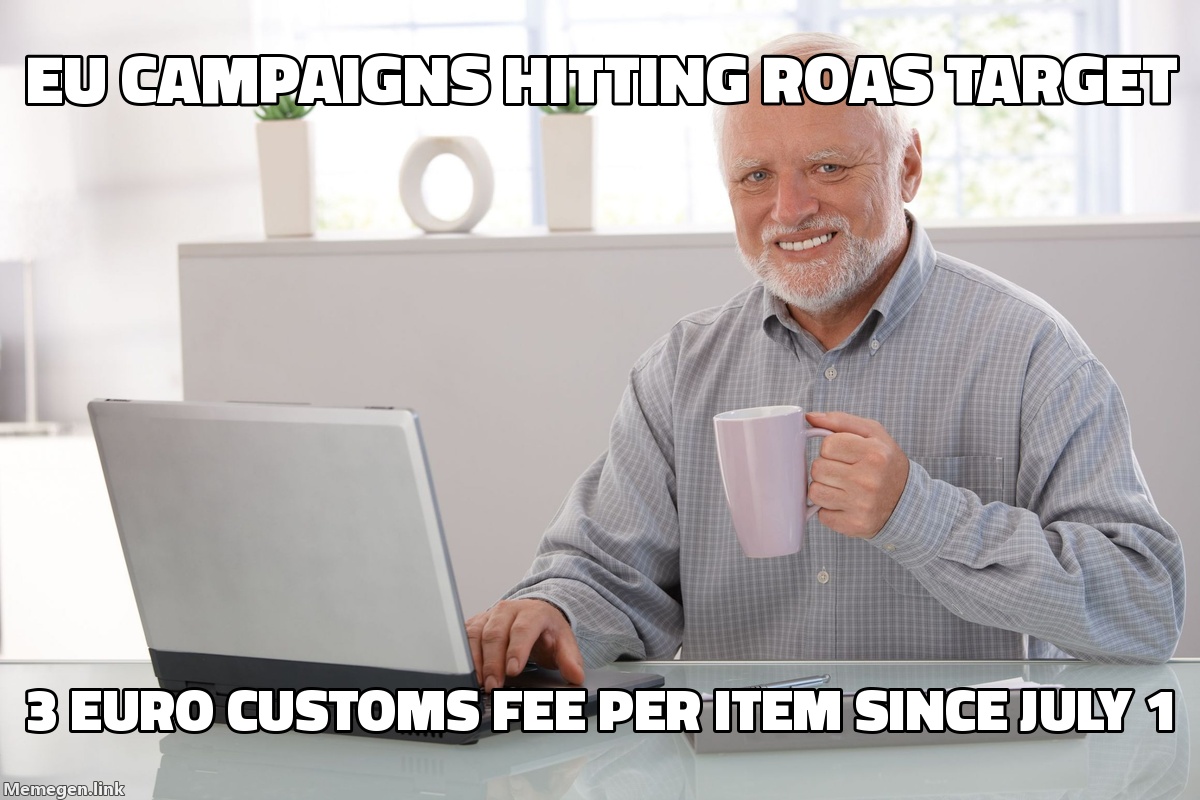
This is the biggest structural shift to EU cross-border e-commerce since IOSS went live in 2021. Most DTC brands haven't adjusted a single bid target in response.
Your ROAS targets are calculated from the wrong baseline
Most brands running EU Meta and Google campaigns set their target ROAS or CPA using historical contribution margin data. That margin was calculated when EU import economics included zero customs duty on sub-€150 shipments. As of July 1, it doesn't.
The €3 item-level charge — plus the processing fees carriers are now passing through for the new electronic customs data requirements — comes directly out of the margin your ROAS is supposed to protect.
If your European gross margin on a €45 product was 40% before July 1, it's lower now. For sub-€50 products in beauty, supplements, accessories, and consumer electronics, the duty alone can cut contribution margin by 5–15 percentage points. Your break-even ROAS went up. Your campaigns don't know that yet, and the platforms don't tell you.
Who takes the hardest hit
Not every European campaign is equally exposed. High-AOV products — premium tech, luxury goods, furniture — absorb the €3 fee without much margin damage. The brands in trouble are those with sub-€50 SKUs, thin margins, and meaningful EU shipping volume.
Beauty and supplements shipped from US or UK warehouses into Germany, France, Italy, Spain, or the Netherlands are the highest-risk category. A €3 item fee on a €20 moisturizer or a €30 protein powder is not a rounding error. It materially changes the unit economics your bid strategy is built on.
Fashion accessories and low-to-mid consumer electronics are the next tier down. If your bestselling EU SKU is a €28 phone case or a €45 pair of earbuds, your margin math just changed without your campaigns knowing.
The compliance problem that could spike cart abandonment
The duty change comes with new paperwork requirements that affect delivery experience, not just landed cost.
The EU now requires standardized electronic shipment data before goods can enter the bloc — precise product descriptions (generic labels like "accessories" or "goods" are now a customs compliance risk), HS classification codes, and detailed seller and buyer information. If your 3PL or logistics provider hasn't updated its customs data workflows, shipments can face delays at the border. Border delays mean split deliveries, elevated customer service load, and abandoned repeat purchases.
Check with your fulfillment provider before assuming the duty fee is your only problem.
What to do before you touch your campaigns
First: rebuild your EU contribution margin model. Get your actual €3 per item duty cost, add your carrier's new processing fee estimate, and recalculate break-even ROAS or CPA for each product tier. Do this before changing any bid targets — updating bids without updating the underlying math just moves the problem.
Second: segment your EU campaigns by average order value. Campaigns hitting €80+ AOV are less exposed. Campaigns running on €25–€45 AOV products need new targets. A single European ROAS target across all SKUs is now actively misleading.
Third: if you have inventory stored in EU fulfillment centers, those shipments don't trigger the import duty. Shipping from within the EU is a cost advantage worth factoring into your logistics planning if EU revenue is material to your business.
Fourth: flag November 2026. That's when the additional HS code handling fee layers on top of the €3. Model the combined €5+ impact before your 2027 planning cycle starts.
If you want to see how these changes affect your specific account margins, the free audit at Gromerce takes about three minutes and surfaces where your EU campaigns are running on outdated economics.
Your European campaigns didn't get less efficient on July 1. Your cost floor did.
Sources: European Commission, Avalara, ShipperHQ, Passport Global, June–July 2026