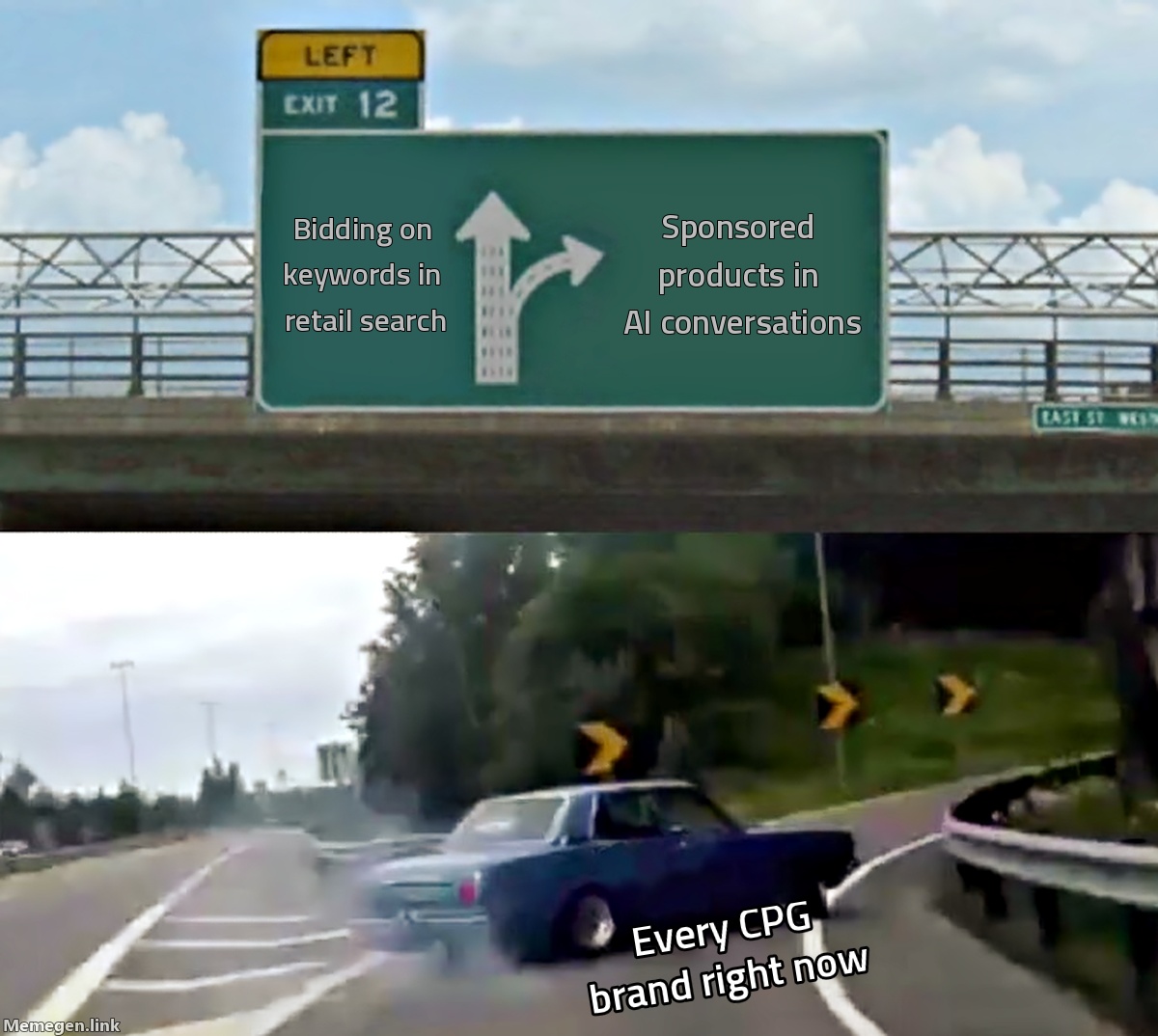
Something happened in grocery retail media this week that most paid media managers aren't tracking yet.
Albertsons Media Collective announced that sponsored products can now appear inside its AI-powered conversational search, powered by Criteo. Albertsons bills itself as the first retailer to add a sponsored slot inside an AI shopping assistant. More than 85% of AI-powered conversations on its platform begin with open-ended or exploratory questions. Not "chicken thighs." Something closer to "what should I make for dinner tonight that's easy and high-protein."
The keyword era of retail media search just got its first official disruption.
What this actually is
When a shopper opens the Albertsons app and asks the AI assistant something open-ended — "what should I buy for a healthy lunch my kids will actually eat?" — the conversational AI now returns a product carousel. Brands that have eligible sponsored products through Criteo can appear in that carousel.
This is not a banner ad bolted onto a chat window. The products appear contextually, within the flow of the AI-generated response, matched to what the shopper was asking about — not to a keyword they typed.
That last part is the whole point.
The 85% number
Albertsons reports that more than 85% of AI-powered conversations on its platform start with exploratory, open-ended questions. If that ratio holds across other retail media networks, it means the overwhelming majority of AI-driven shopping intent doesn't map to a keyword at all.
Traditional retail media sponsored search requires a keyword match. You bid on "organic almond butter," you appear when someone searches "organic almond butter." That model still works for high-intent, bottom-of-funnel searches.
But it misses 85% of where AI shoppers actually are.
Why Criteo matters here
Criteo isn't just a tech partner for one grocery chain. They operate one of the largest commerce advertising stacks across retail media, connecting brands to inventory at Carrefour, Costco, Target, and dozens of other retailers globally.
What Albertsons announced is not a single-retailer experiment. It's a proof of concept for a capability Criteo can deploy across its entire network. If you're running sponsored products on any Criteo-powered retail media network, this is the direction your placements are heading.
What needs to change on your end
The keyword optimization mindset doesn't transfer to AI conversational search. When the query is "something quick and high-protein for weeknight dinners," your product wins or loses on contextual relevance, not keyword matching.
Two things that matter now more than bid level:
- Product descriptions that answer use-case and occasion questions outperform spec-heavy copy in conversational AI carousels
- A+ content explaining when and why to use a product consistently beats content explaining what it is
The brands over-indexed on keyword bidding and under-invested in content quality will find this transition uncomfortable. The brands that treated their retail media feeds like SEO copy — stuffed with attributes, thin on context — have a cleanup job ahead.
The wider pattern
This Albertsons announcement is one data point in a pattern you've probably already seen across Google AI Mode, ChatGPT shopping results, and Alexa for Shopping: the discovery layer is moving from keyword matching to intent interpretation.
Retailers are in a race to monetize AI-mediated discovery before Amazon locks in the standard. Albertsons went first with a concrete, buyable format. Kroger, Walmart, and Target are not far behind.
If your retail media strategy is still mostly "bid on the right keywords, optimize CTR on sponsored products," you're optimizing for a surface that's shrinking. The new inventory is in the conversation. Getting there requires better product data — not higher bids.
If you want to see where your product feed and retail media setup actually stand, the Gromerce audit tool gives you a clear read in about three minutes.
The keyword isn't going away. It's just no longer the only door in.
Sources: Albertsons Companies newsroom, BusinessWire, Grocery Dive, Progressive Grocer, June 2026